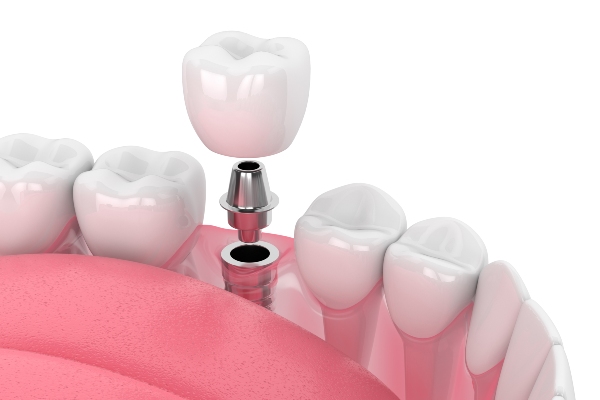
Patients looking to replace missing or failing teeth may benefit from dental implants, a long-lasting dental restoration that mimics the function and form of real teeth. Depending on the patient's oral health, implant dentists use two types of implants: endosteal and subperiosteal. In this blog, we will closely examine the different types of implants and when each is necessary.
Types of dental implants
An implant dentist will use either endosteal or subperiosteal dental implants to restore a patient's smile. While oral surgery is necessary for both, each is placed differently concerning the jawbone. Explore the differences below.
Endosteal implants
Endosteal implants are preferable for patients who have enough healthy bone for the implants to attach to the jawbone. The implant is a biocompatible metal post (usually titanium) placed into the jawbone through surgery. The goal is to help the jawbone fuse with the implant to create a new tooth root. This process can take several months.
For a better picture, endosteal implants resemble metal screws on which a dental crown will sit to restore the tooth. (An abutment will help the crown attach to the implant.) Crowns can also restore damaged teeth, such as from tooth decay. They can also contain porcelain or ceramic materials to look like natural teeth.
These are the most common implants, typically recommended for patients with bridges or tried dentures.
Subperiosteal implants
Subperiosteal implants are beneficial when the patient does not have enough healthy bone for endosteal implants. The implant dentist will not place these into the jawbone; they will place them on top or right above it. Oral surgery is still required, as they must sit under the gums.
Subperiosteal implants are less common but remain a highly effective dental restoration. While many people have enough healthy bone to qualify for endosteal implants (i.e., through bone grafting), only some people wish to do so. Subperiosteal implants would be the clear option in these cases. They are also recommended for patients who cannot use traditional dentures.
How many implants do you need?
Both endosteal and subperiosteal implants can replace one or multiple teeth. It depends on how many teeth are missing and where they are missing in relation to each other.
An implant dentist may replace one or two missing teeth spaced out from each other (e.g., one missing tooth on the upper jaw and one on the lower jaw) with singular implants. Implants can be the most effective restoration in these cases, as a dental bridge would require the surrounding teeth to be ground down so that dental crowns can be placed on top for support. Neither an endosteal nor subperiosteal implant requires this. In addition, by opting for an implant, the patient can keep more of their natural teeth.
Multiple implants are recommended when a few adjacent teeth are missing. Implant-supported dental bridges (instead of bridges supported by dental crowns on natural teeth) can be used to fill larger gaps. If all the teeth are missing from the upper or lower jaw, full-arch prosthesis may be recommended. This option is a fixed denture cemented in place by four to six dental implants.
Consult an implant dentist
Many factors go into choosing the right type of implant for each patient’s needs. During a consultation, an implant dentist can discuss the options and basic types of implants in greater detail. To get started, call our office.
Request an appointment or call Metcalf Dental at 630-203-9779 for an appointment in our Oak Brook office.
Related Posts
Dental veneers and dental crowns are restorations that can change the appearance of your teeth. Though they are different procedures, people often confuse the two. This article will review the key differences between crowns and veneers to help you better understand which procedure is right for you.A dental veneer is a thin covering for a…
An Invisalign® dentist offers a modern, comfortable, and discreet solution for patients seeking orthodontic treatment without the hassle of traditional metal braces. Invisalign clear aligners have gained popularity for their ability to deliver effective results with greater convenience and minimal interference with daily life. Choosing an Invisalign dentist ensures personalized guidance through each stage of…
Many people want brighter teeth, a more even shape, or a fuller smile, but do not know how to achieve it. A smile makeover can help patients achieve each of these goals. These treatment plans blend art, science, and customization to create a healthy, confident smile that fits personal wants and needs. A general dentist…